Home / Robotics
Next batch starts December 2026 at our Chennai centre.
Robotics, from first circuit to autonomous robot.
Eight levels, from Grade 4 to college. Students build a working robot at every level and present it at Demo Day. The academy supplies the kits, one for every team of three.
- Who
- Grade 4 to college
- Where
- Our Chennai centre, or at your school
- Kits
- Supplied, 1 per team of 3
- Batches
- Weekends
- Fee
- On enquiry, per level
Eight levels. Start where you are.
Students start at the level for their grade. A short practical check can move them up or down one level. College students and adults new to electronics start at Level 5.
-
Level 1
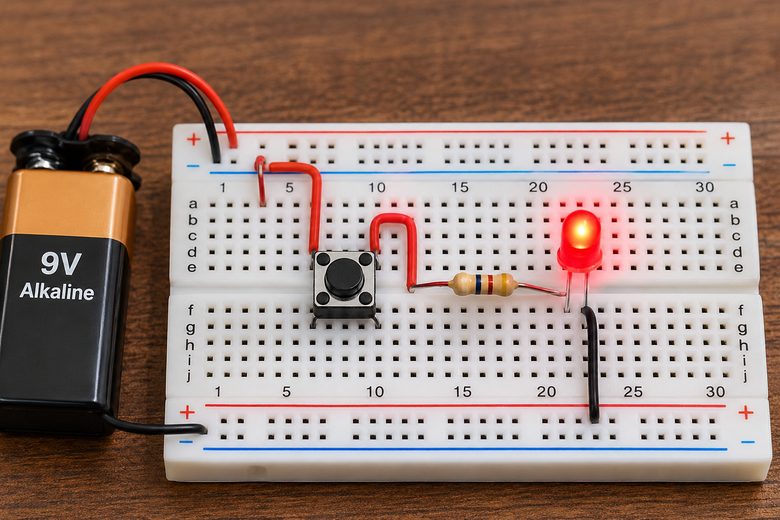
A switch-and-LED circuit on a breadboard
-
Level 2
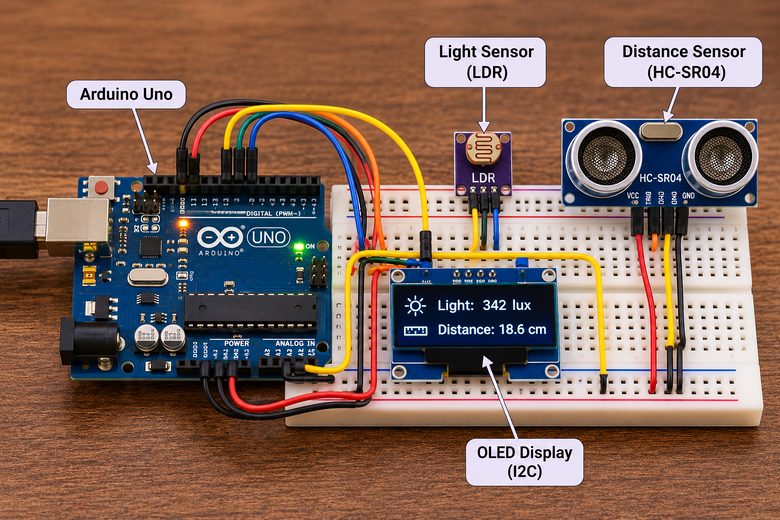
An Arduino reading light and distance sensors
-
Level 3
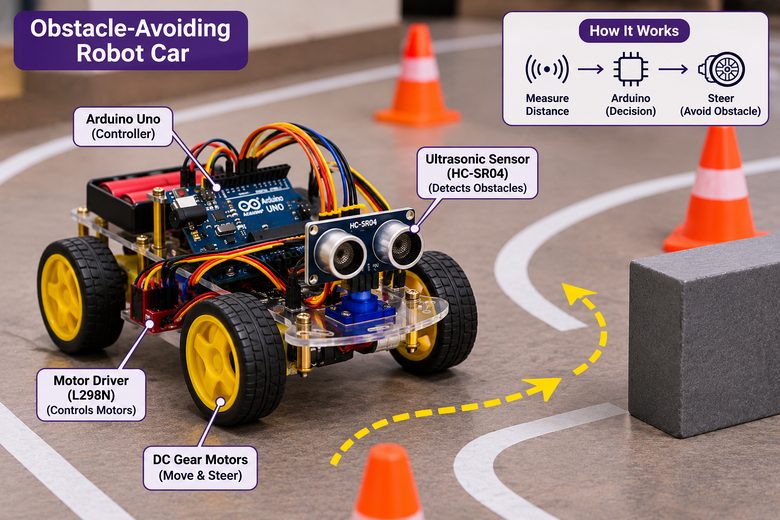
A robot car that steers around obstacles
-
Level 4
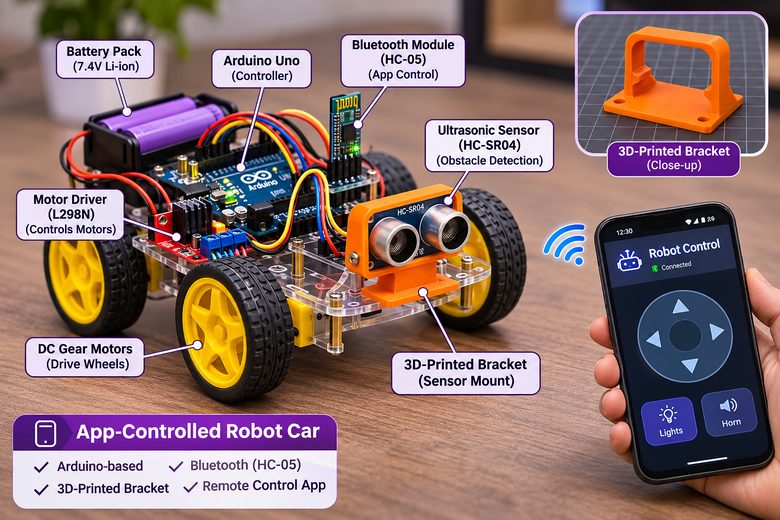
An app-controlled robot with a 3D-printed bracket
-
Level 5
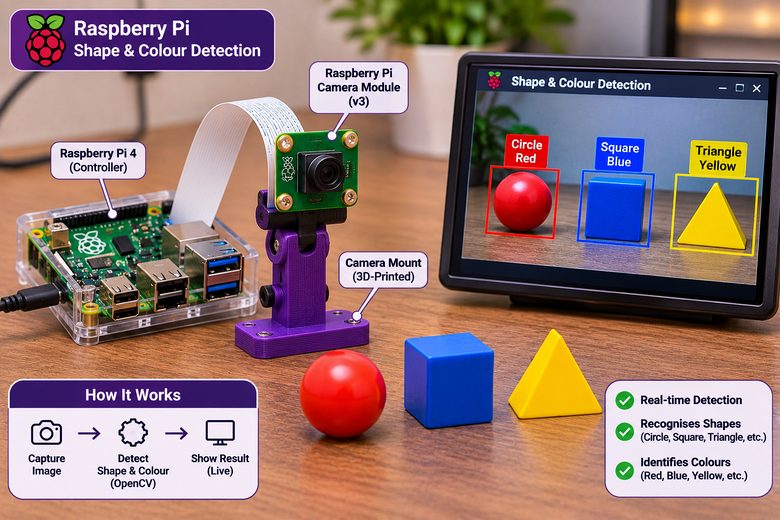
A Raspberry Pi camera that spots shapes and colours
-
Level 6
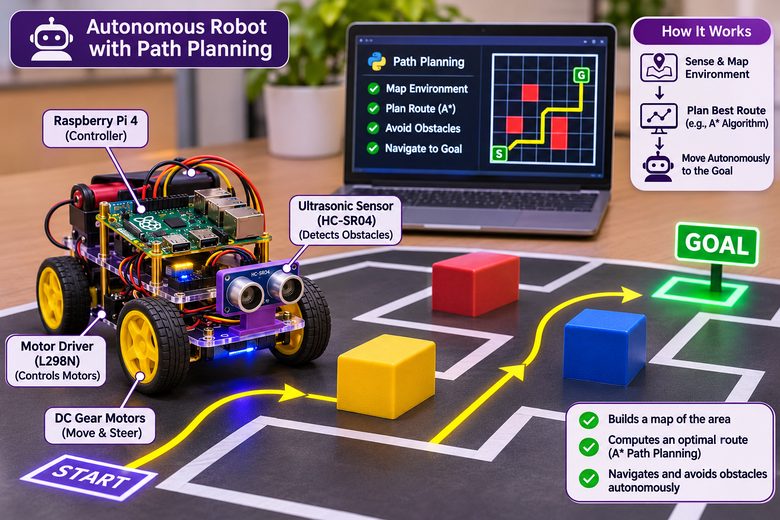
A robot that plans its own route
-
Level 7
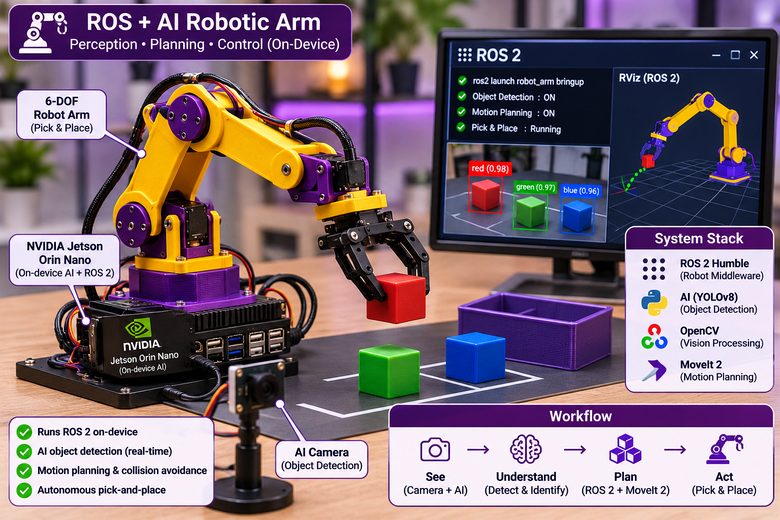
A robot arm running ROS with AI on the device
-
Level 8
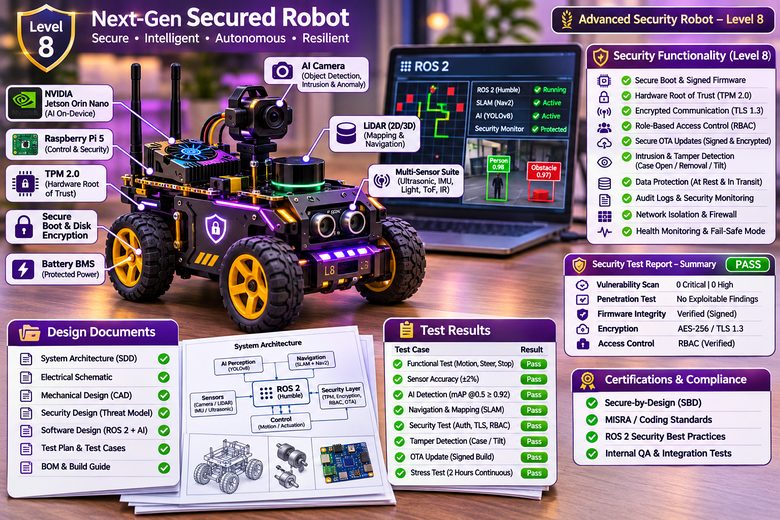
A secured robot, with design documents and test results
Level 1Junior Entry Grades 4 and 5
What you’ll learn
- Build simple circuits with batteries, LEDs, switches and motors, and explain why each one works.
- Design and test a circuit in Tinkercad before building it on a breadboard.
- Program a microcontroller with block-based code to blink lights, read a button and drive a motor.
- Build and present a small moving model at Demo Day.
Skills you gain
Basic circuits, breadboarding, block-based coding, Tinkercad, presenting a project.
Prerequisites
Reads and follows simple instructions. No prior experience needed.
Level 2Junior Pro Grades 6 and 7
What you’ll learn
- Wire and program an Arduino from scratch, moving from blocks to simple text code.
- Read sensors for light, distance and temperature, and make a robot react to them.
- Build a line-following robot and tune it to stay on the track.
- Explain your build and its code to an audience at Demo Day.
Skills you gain
Arduino, sensor input, motor control, introductory Arduino C++, debugging a physical build.
Prerequisites
Level 1, or can build a simple circuit and write block-based code.
Level 3Sub Senior Entry Grades 8 and 9
What you’ll learn
- Build an obstacle-avoiding robot that combines several sensors.
- Control servos and DC motors through motor drivers, with speed and direction control.
- Write structured Arduino programs with functions and state, and fix them when the robot misbehaves.
- Document a build with a wiring diagram in Fritzing and a short write-up.
Skills you gain
Multi-sensor robots, motor drivers and servos, structured embedded C++, wiring diagrams, build documentation.
Prerequisites
Level 2, or can program an Arduino to read a sensor and drive a motor.
Level 4Sub Senior Pro Grade 10
What you’ll learn
- Design and 3D-print a custom mechanical part for a robot, then fit and test it.
- Combine readings from more than one sensor to make steadier decisions.
- Build a remote-controlled or app-connected robot.
- Enter a robot in an ORI Robotics League round and review how it performed.
Skills you gain
3D design and printing, sensor fusion basics, wireless control, competition preparation.
Prerequisites
Level 3, or can build and program a multi-sensor Arduino robot.
Level 5Senior Entry Grade 11, and college students new to robotics
What you’ll learn
- Set up a Raspberry Pi and program it in Python.
- Use OpenCV to detect colours, shapes or faces from a camera feed.
- Connect a Raspberry Pi to an Arduino so the robot can see and act.
- Build a robot that follows or sorts objects by what it sees.
Skills you gain
Raspberry Pi, Python, computer vision with OpenCV, linking two controllers.
Prerequisites
Level 4, or can program an Arduino robot. College students and adults need basic programming in any language and a laptop.
Level 6Senior Pro Grade 12
What you’ll learn
- Build an autonomous robot that plans its own route around obstacles.
- Run the Robot Operating System (ROS) at an introductory level: nodes, topics and simulation.
- Show how a connected robot can be attacked, through open ports, default passwords or unsigned updates, and add basic protections.
- Present a complete autonomous robot project at Demo Day.
Skills you gain
Autonomous navigation, introductory ROS, robot simulation, cyber-physical security basics, project presentation.
Prerequisites
Level 5, or can program a Raspberry Pi in Python and use a camera for vision.
Level 7Sup Senior Entry College, year 1 of 2
What you’ll learn
- Build ROS-based robot software with several nodes, and test it in simulation before running it on hardware.
- Integrate a trained AI model for vision or decision-making on an edge device.
- Apply basic control theory to make motion smooth and stable.
- Write a design document covering requirements, parts, risks and a test plan.
Skills you gain
ROS development, simulation, AI on edge devices, control basics, engineering documentation.
Prerequisites
Level 6, or an engineering or science undergraduate who can program in Python or C++ and has built at least one microcontroller project.
Level 8Sup Senior Pro College, year 2 of 2
What you’ll learn
- Design, build and test a complete robotic system that solves a stated problem, as a team.
- Secure the system end to end: device access, communication and software updates.
- Run a structured test campaign and fix what it finds.
- Defend the project in front of a panel, with design documents, code and test results.
Skills you gain
System design, team engineering, robot security, test planning, technical presentation, a complete project portfolio.
Prerequisites
Level 7, or equivalent ROS and embedded experience shown in a placement project.
How classes run
- Small batches working in teams of three, one kit per team
- Soldering irons, power tools and 3D printers used only with an instructor present
- A Demo Day at the end of every level, with parents invited
- ORI Robotics League rounds for students who want to compete
For schools
We also run Robotics as workshops inside schools, for Classes 4 to 9, with kits supplied.
Tools used across the levels: Arduino, Raspberry Pi, ROS, OpenCV, Tinkercad, Fritzing, Python, C++ and 3D printing.
At our centre in Chennai.
All robotics levels run in person at our learning centre. Classes are small groups — a maximum of eight students per batch.
No. 283, Railway Station Road Korattur, Chennai 600 080Book a free trial class.
We’ll assess the right starting level for your child — or for you — during the trial, at no cost.
Or ask on WhatsApp — we reply within the hour on weekdays.
Questions? We’re easy to reach.
Call, WhatsApp, or fill in the enquiry form — whichever you prefer.